Ubertar Hexaphonic Pickups
and polyphonic pickups for bass and
seven-stringed guitar
..............................................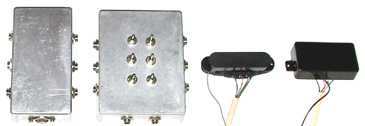
from left to right: hex breakout box, hex plus stereo breakout box, hex (divided) single coil pickup in strat-style case, hex (divided) humbucker. (not pictured: p-bass, j-bass)
Click here for single-string (one-string) or two-string pickups. HC-series one-string pickups are ideal for a modular design or for custom spacing. Put them in any style of case, or no case. Available in reverse polarity (color coded) for wiring as humbucker pairs.
Why passive? .......
Because passive electromagnetic pickups are what we know and love as the sound of the electric guitar. You could start with piezos or active pickups and try to emulate or simulate, but why not start out with the real deal? Ubertar pickups are the real deal. Passive electromagnetic. Coils and magnets. No batteries. No active electronics. No preamps. The real tone you expect from an electric guitar.
Visit the Products page to order.
contact: ubertar@gmail.com
| Welcome to
the Ubertar Hexaphonic guitar pickup page. We are a small
company (currently just one person-- Paul
Rubenstein, that's me) specializing in passive,
electromagnetic, polyphonic pickups for stringed musical
instruments, particularly hexaphonic guitar pickups.
A hexaphonic guitar pickup (sometimes called a divided pickup) is a pickup with six outputs (one for each string on the guitar). Polyphonic pickups are pickups with multiple outputs of any number, including heptaphonic pickups for seven-stringed guitars, quadraphonic pickups for bass. All of my pickups are passive and electromagnetic - these sound much better than piezo or active pickups, which are usually meant for MIDI applications, rather than direct audio output. Ubertar polyphonic pickups are typically wired to a multi-pin output (7 or 13 pin) and connected via a cable to a breakout box with one 1/4" output jack per string. A breakout box can also be set up with additional stereo outputs and a left/right switch for each string. I also make one-string (single string, individual) pickups and two-string pickups. *Ubertar hexaphonic pickups are compatible with Roland VG-99 and GR-20 processors (guitar synths). |
|
"I was searching for a pickup that could be installed on an acoustic guitar (without permanent modification), that would allow separate outputs for the bass strings. I was amazed to find that the Ubertar pickup fits the bill exactly. By mounting it in the sound-hole I can send the signal to an octave-divider pedal and still use the piezo pickup for regular acoustic sounds. This allows me to give the impression of playing bass and guitar at the same time, or just reinforce the bottom two strings with a lower octave. The pickup is all passive, so no extra batteries required, and is super quiet too, and isolates the individual strings very well. It also looks like a regular single coil and can be mounted in any way a regular strat pickup can be mounted. This has become a major part of my setup. Great work Paul! - Ben Butler (Sting, George Michael, Paula Cole)
"I've seen a lot of guitars. Heck, I've owned a lot of guitars. Those HS (hexaphonic stereo) guitars are some of the best I've ever seen (or heard). Good job." - Steve Ripley, designer of the Kramer Ripley stereo guitar, including the one used by Eddie Van Halen
"I'm loving the pickup. Happy to have found you, great work!" - Jeff Lang
"You are awesome. We are using the HELL out of this thing and these swept arpeggios at mach 5 are sounding incredible. The separation is astounding. Really. Like almost NO crosstalk sometimes depending on the part. That is incredible. I LOVE the hexaphonic pickup guitar, a LOT. It is simply perfect for the way I think music should sound." - Joel Hamilton, Studio G Brooklyn
"I want you to know that over the years, I've had Hex pickups built for me by Bartolini, Alembic, and Jason Lollar, and none of them worked as well as yours. I just thought I'd let you know. Thanks again!" - Joe Esposito (East Haven, CT, USA) |
©Paul Rubenstein/Ubertar. All rights reserved.